Introduction
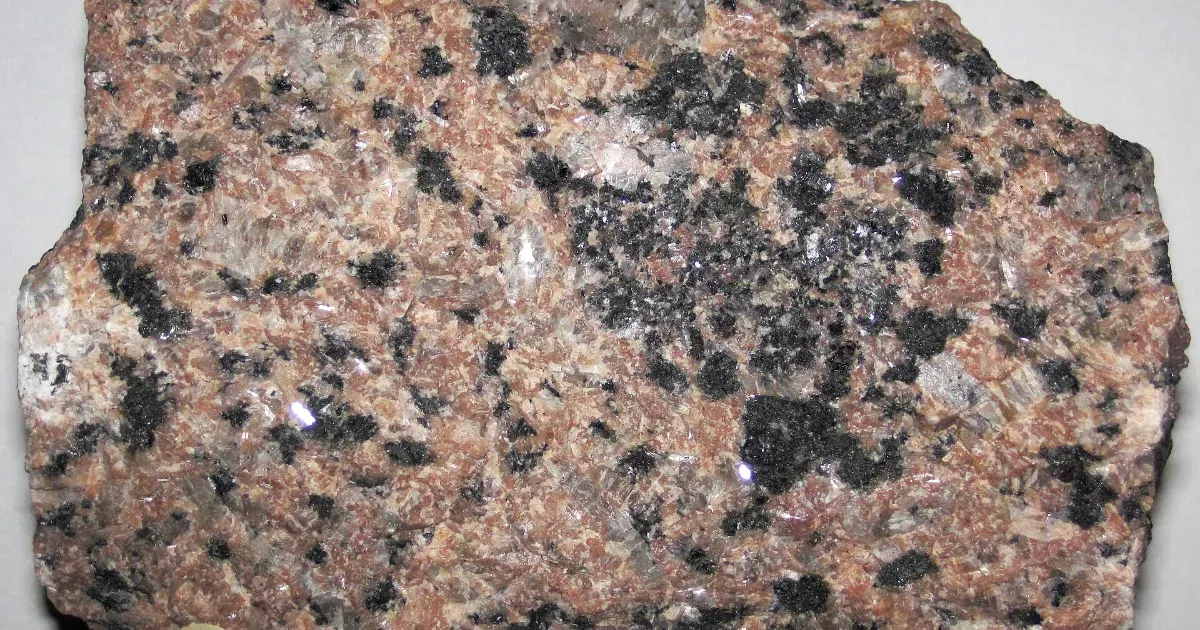
Nepheline syenite is a light-colored (leucocratic), usually coarse-grained, quartz-free intrusive igneous rock that forms from silica-undersaturated alkaline magmas. In part one of this series we examined the mineral nepheline in detail. The industrial behavior of the rock, however — its alumina and alkali grade, iron content, hardness and processability — is the product of its entire mineral assemblage. In this article we review the minerals that make up nepheline syenite, from major to accessory.
Definition and Classification: What Exactly Is Nepheline Syenite?
Under the International Union of Geological Sciences (IUGS) QAPF classification, a rock is called nepheline syenite (foid syenite) when:
- feldspathoids (mainly nepheline) make up 10–60% of its light-colored minerals;
- plagioclase is less than 10% of total feldspar, i.e. the dominant feldspar is alkali feldspar;
- it contains no primary quartz, because quartz and nepheline are not stable together and react to form feldspar.
Nepheline syenites typically contain 50–60% SiO2 and are geochemically "silica-undersaturated". Several varieties carry their own names:
- Foyaite: nepheline syenite dominated by K-feldspar with few mafic minerals.
- Litchfieldite: albite-rich nepheline syenite with cancrinite and sodalite.
- Ditroite: a variety rich in microcline, sodalite and cancrinite.
- Lujavrite: a dark variety rich in aegirine and arfvedsonite (agpaitic).
- Urtite and ijolite: very nepheline-rich rocks with little feldspar, which are in fact foidolites.
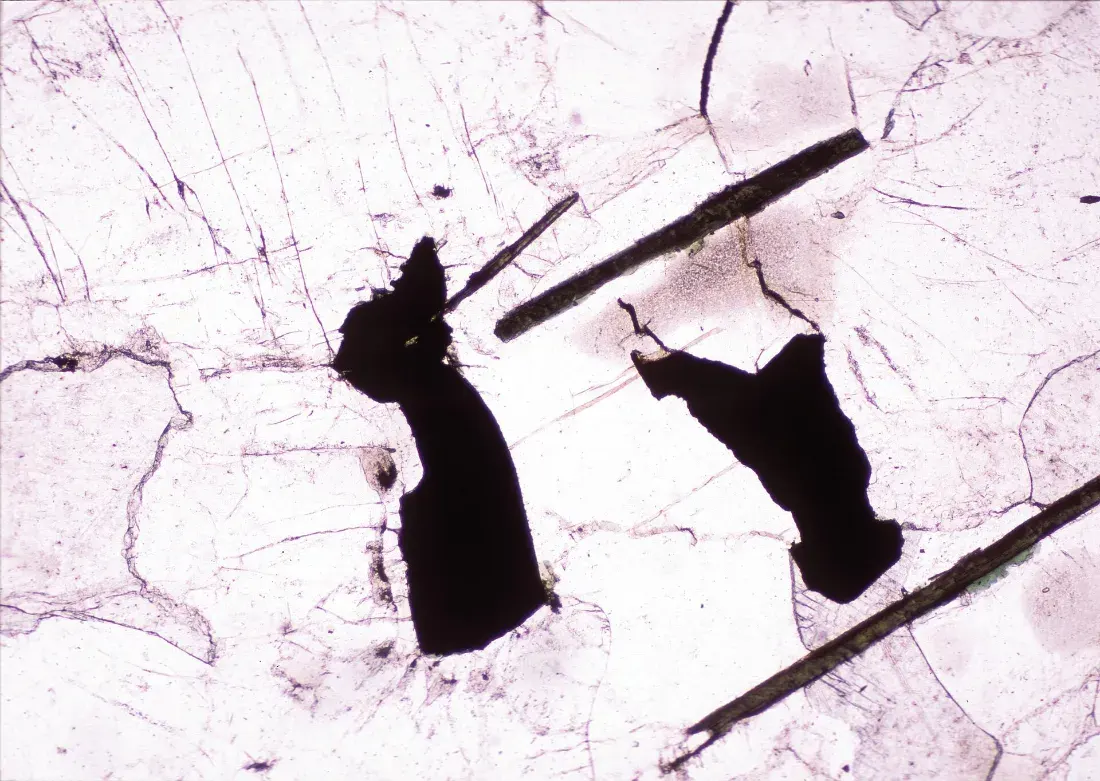
Figure 1 – Thin section of nepheline syenite in plane-polarized light: anhedral albite and nepheline with dark (opaque) minerals. Photo: Darla Sondrol, GeoDIL collection, CC0 (Wikimedia Commons)
Modal Composition: Leading Nepheline Syenites Worldwide and in Iran
The modal (mineralogical) composition of nepheline syenite varies markedly from one deposit to another, and this variation determines the chemistry of the final product. Three reference examples:
- Blue Mountain, Ontario (Canada): about 54% albite, 18% microcline, 18% nepheline and 4% biotite, with minor muscovite and magnetite. The dominance of albite makes this product sodic.
- Stjernøy (Norway): the raw ore contains about 33% nepheline and 54% potassium feldspar, and its iron content falls from about 2.75% Fe2O3 in the ore to about 0.1% in the final product. The dominance of K-feldspar gives a more potassic product.
- Kaleybar, East Azerbaijan (Iran): according to Hajialioghli, Moazzen and Milke (2011), K-feldspar makes up 30–35%, plagioclase 20–30%, nepheline up to 25% and amphibole 15–20% of the rock by volume.
This comparison shows that the proportion of mafic minerals (biotite, amphibole, pyroxene and iron oxides) is the most important processing variable, since these minerals carry most of the iron and must be removed as completely as possible.
1. Major Light-Colored Minerals
Alkali Feldspars
Alkali feldspar is the most abundant mineral in most nepheline syenites. It usually occurs as perthite: potassium feldspar (orthoclase or microcline) from which lamellae or veinlets of sodic albite exsolved during cooling. In some deposits, such as Blue Mountain, albite is also abundant as separate grains.
- Microcline and orthoclase: KAlSi3O8; the main source of K2O in the product
- Albite: NaAlSi3O8; a source of Na2O alongside nepheline
- Perthite and antiperthite: intergrowths of the two phases, visible under the microscope and even by eye
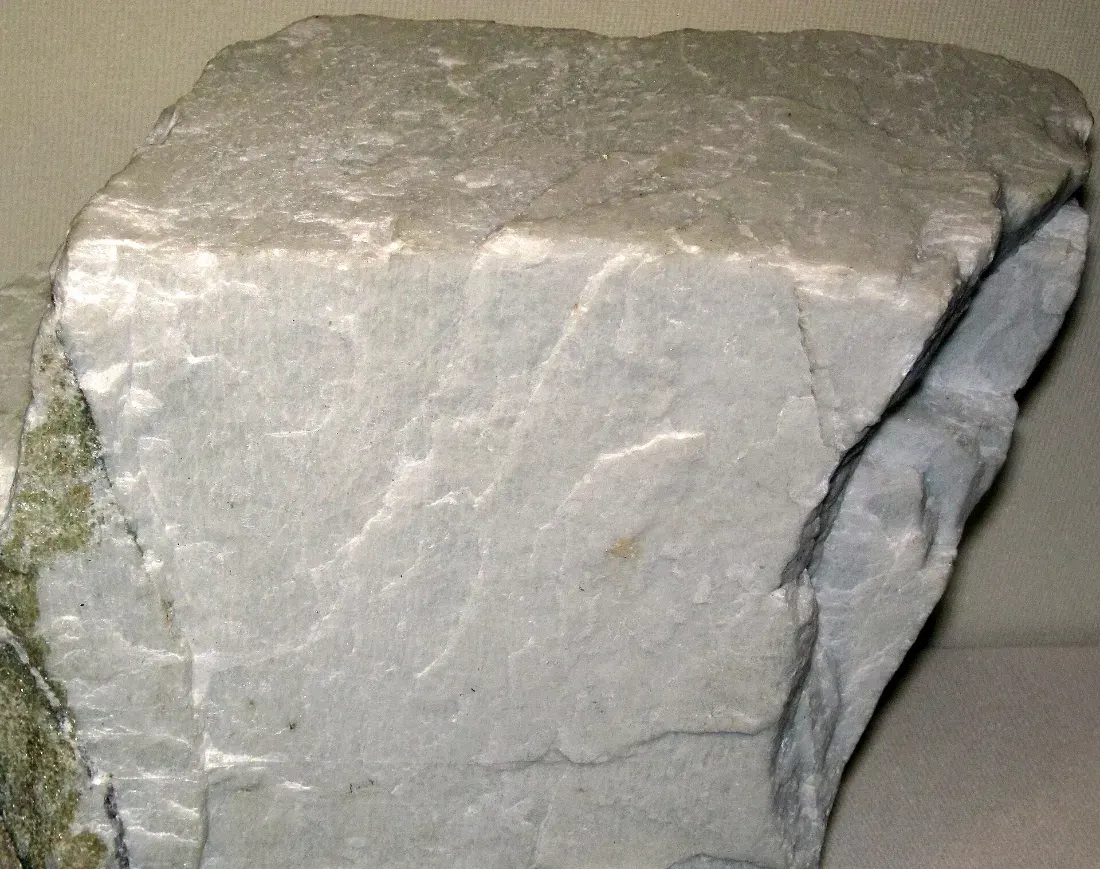
Figure 3 – Perthitic feldspar with albite veinlets in a K-feldspar host. Photo: James St. John, CC BY 2.0 (Wikimedia Commons)
Nepheline
Nepheline usually makes up 15–35% of the rock, occurring as gray, greasy, anhedral grains between feldspar crystals. Its structure and properties are covered in part one of this series.
2. Associated Feldspathoids
- Sodalite, Na8Al6Si6O24Cl2: a chlorine-bearing feldspathoid with a characteristic deep-blue color, more common in chlorine-rich nepheline syenites.
- Cancrinite: a carbonate-bearing feldspathoid, usually pale yellow to pink, often formed by alteration of nepheline.
- Analcime, NaAlSi2O6·H2O: classed by some as a feldspathoid and by others as a zeolite; usually secondary.
- Natrolite: a sodium zeolite formed at late, hydrothermal stages.
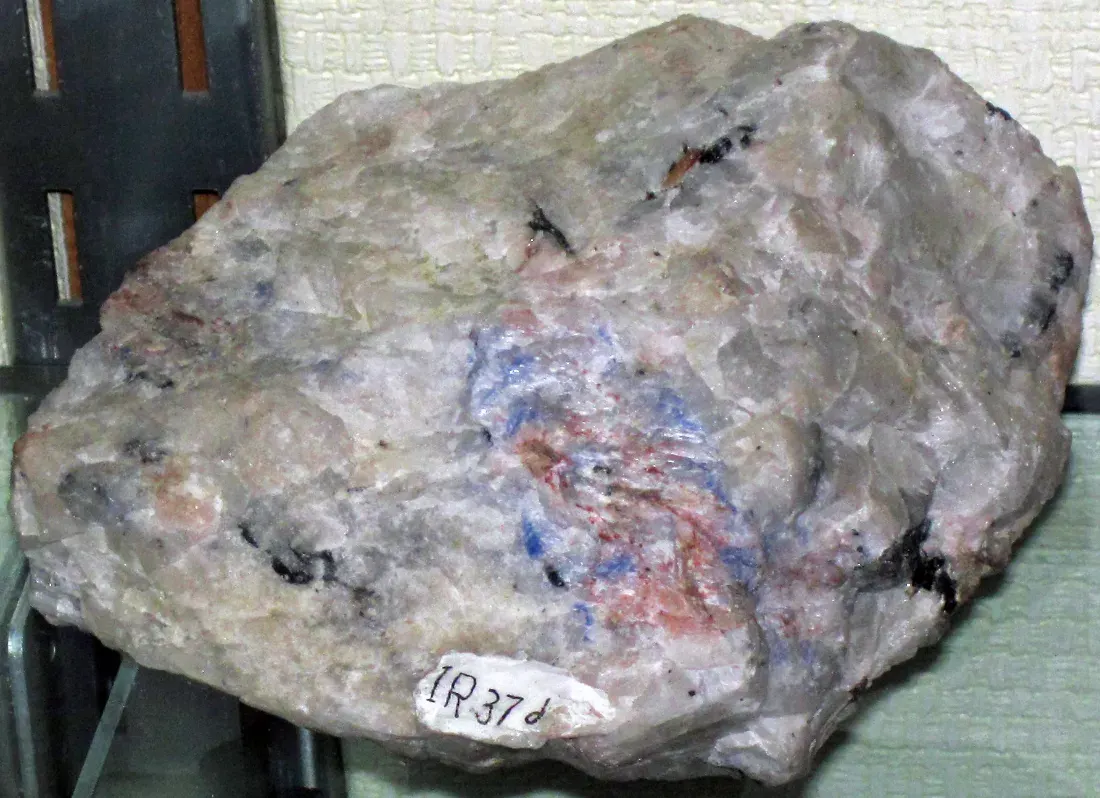
Figure 4 – Blue sodalite in Precambrian nepheline syenite from Bancroft, Ontario (Canada), with gray nepheline and white feldspar. Photo: James St. John, CC BY 2.0 (Wikimedia Commons)
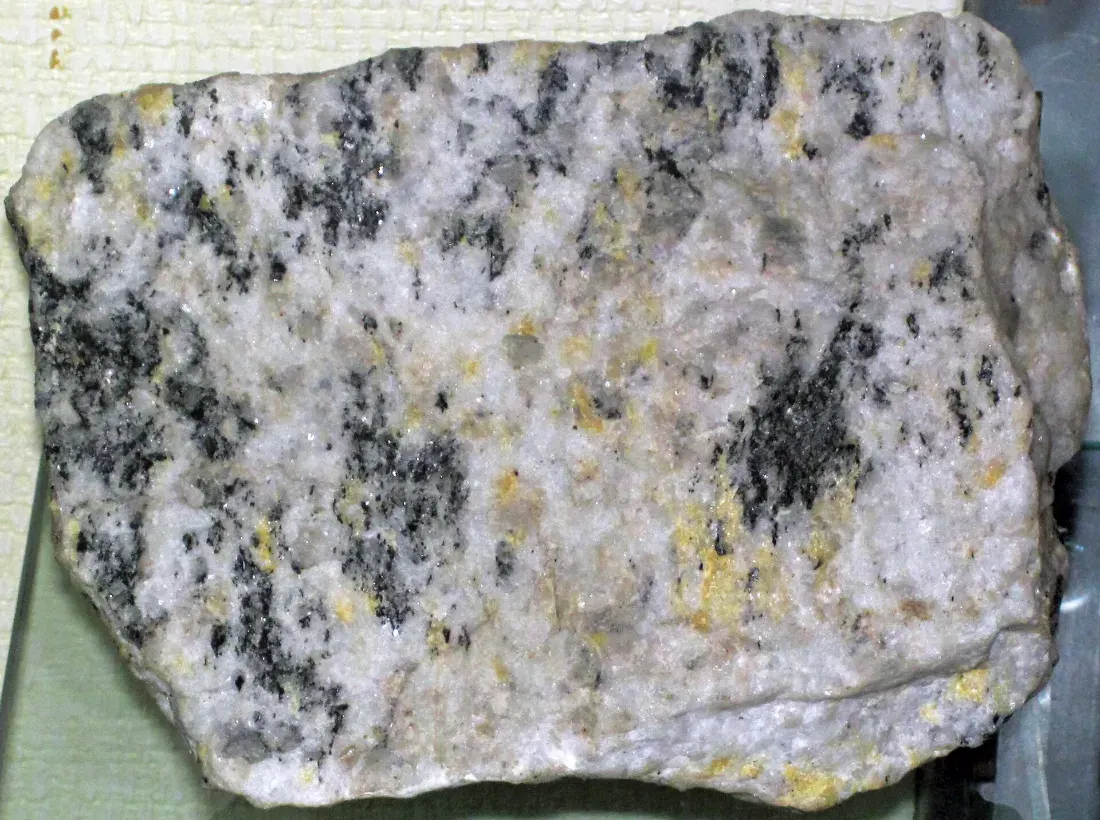
Figure 5 – Litchfieldite, an albite- and cancrinite-rich variety of nepheline syenite from Maine, USA. Photo: James St. John, CC BY 2.0 (Wikimedia Commons)
Industrially, these feldspathoids are generally harmless and contribute Na2O and Al2O3, but cancrinite and zeolites raise the product's loss on ignition (LOI) because they contain CO2 and water, and sodalite can introduce some chlorine into the melt.
3. Mafic (Ferromagnesian) Minerals
Mafic minerals usually make up 5–20% of nepheline syenite, and their type depends on magma composition:
- Sodic pyroxenes: aegirine, NaFe3+Si2O6, and aegirine-augite; dark green to black prisms.
- Sodic amphiboles: arfvedsonite, riebeckite and hastingsite; amphibole is the dominant mafic mineral at Kaleybar.
- Micas: biotite and annite (iron-rich biotite); the main mafic mineral at Blue Mountain.
- Iron-rich olivine (fayalite) and aenigmatite in some varieties.
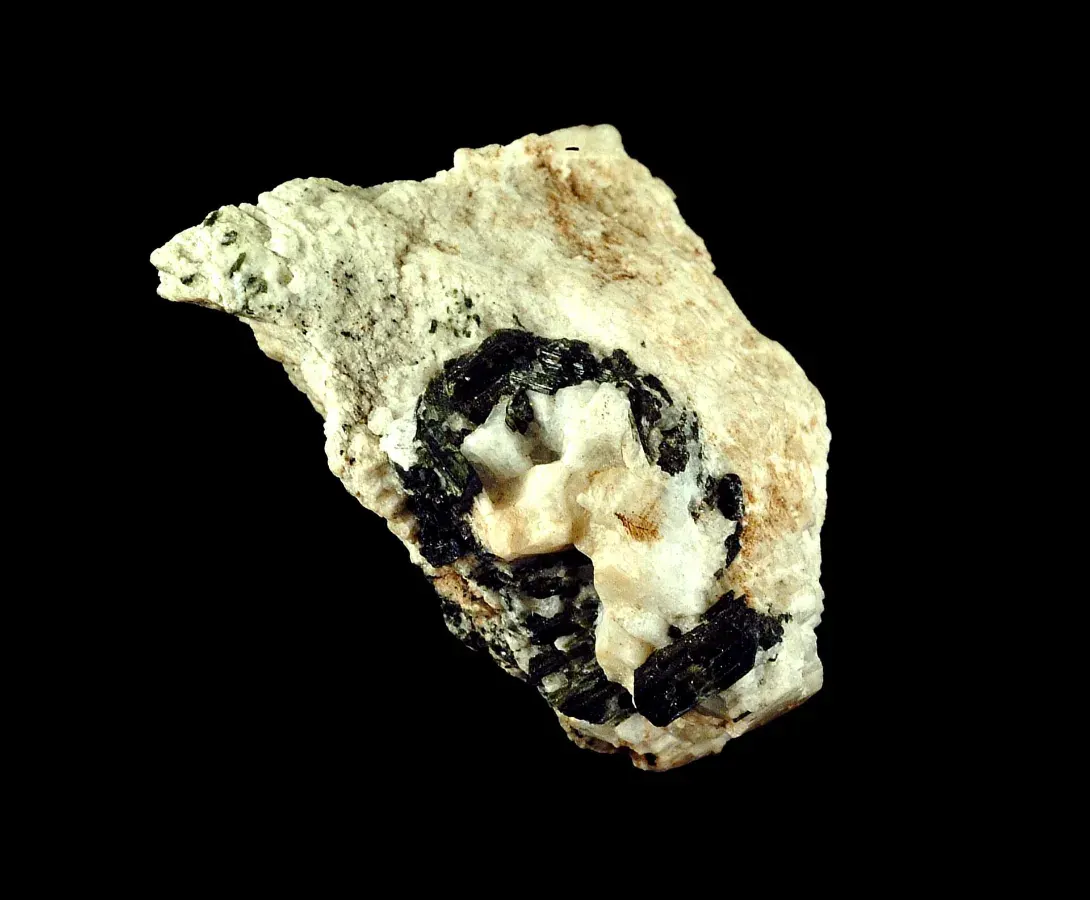
Figure 6 – Black aegirine (sodic pyroxene) crystals in albite from Langesundsfjord, Norway. Photo: Shannon Heinle, GeoDIL collection, CC0 (Wikimedia Commons)
Industrial note: almost all of these minerals are paramagnetic, so they can be removed with high-intensity magnetic separators (HIMS/WHIMS). For this reason, final product quality depends less on the total iron of the ore than on the degree of liberation of these minerals at the grind size, and on how much iron sits inside the lattice of the light-colored minerals.
4. Accessory Minerals
- Magnetite and ilmenite: iron and titanium oxides; magnetic and relatively easy to remove.
- Titanite (sphene): CaTiSiO5; a source of titanium in the product.
- Apatite: calcium phosphate, in minor amounts.
- Zircon: less common in nepheline syenites than in granites.
- Titanian garnet (melanite and schorlomite): brown to black Ti-rich garnet; reported in the Kaleybar nepheline syenite with 1.5–5 wt% TiO2.
- Fluorite, calcite and pyrochlore in some deposits.
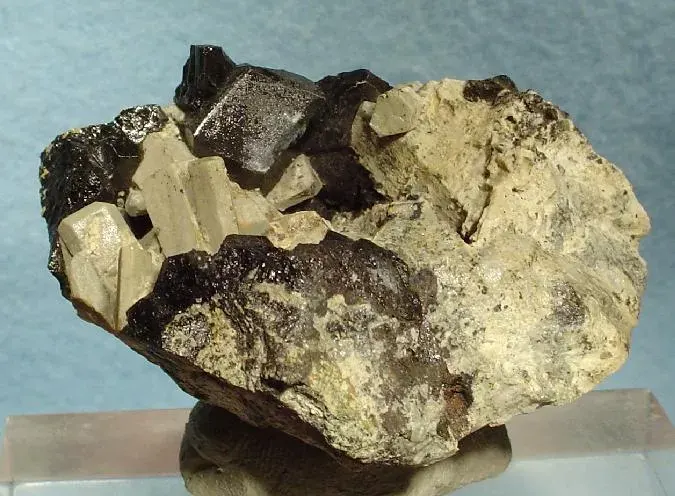
Figure 7 – Black schorlomite (titanian garnet) with nepheline from the Tamazeght complex, Morocco. Photo: Robert M. Lavinsky, CC BY-SA 3.0 (Wikimedia Commons)
5. Miaskitic or Agpaitic?
Nepheline syenites are divided into two large groups by their agpaitic index, the molar ratio (Na+K)/Al:
- Miaskitic: index below 1. Mafic minerals include biotite, hornblende and aegirine-augite, and Zr and Ti are hosted by zircon, titanite and ilmenite. The industrial deposits of Blue Mountain and Stjernøy are of this type.
- Agpaitic: index above 1 (peralkaline). Mafic minerals are mainly aegirine and arfvedsonite, and Zr and Ti are concentrated in complex silicates such as eudialyte, lamprophyllite and astrophyllite. The Lovozero and Khibiny complexes in Russia and Ilímaussaq in Greenland are well-known examples.
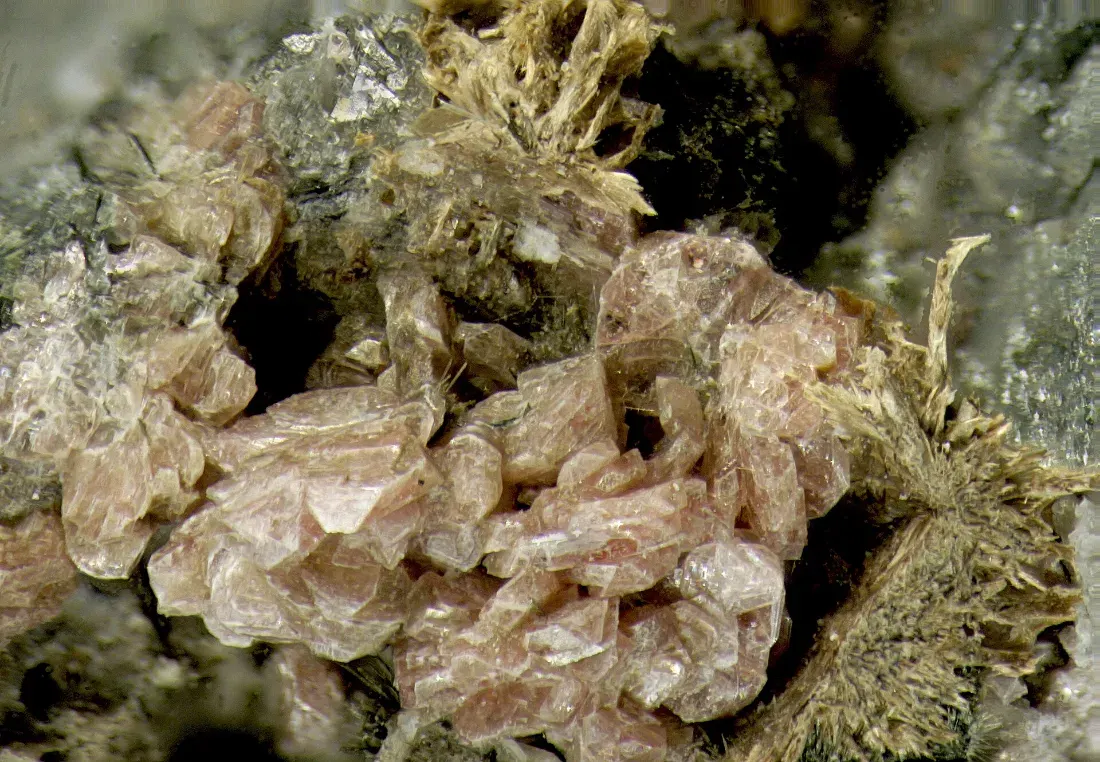
Figure 8 – Eudialyte crystals, the signature mineral of agpaitic nepheline syenites and a potential source of zirconium and rare earth elements (field of view 2.25 × 3 mm). Photo: Modris Baum, public domain (Wikimedia Commons)
For glass and ceramics, miaskitic, low-iron nepheline syenites are the most valuable, because their mafic minerals are easier to remove. Agpaitic nepheline syenites, by contrast, attract interest mainly as sources of rare earth elements, zirconium and niobium.
6. Texture and Grain Size
Nepheline syenite is usually medium- to coarse-grained and granular, and in places pegmatitic or gneissic (in metamorphosed examples such as Blue Mountain in the Grenville Province). Grain size has two direct industrial consequences:
- Liberation: the coarser the grains, the coarser the grind at which mafic minerals are liberated, and the more efficient magnetic separation becomes.
- Grinding energy: moderate hardness (about 6 on the Mohs scale) and the absence of quartz reduce equipment wear compared with silica sand.
Conclusion
Nepheline syenite is an assemblage of alkali feldspars, nepheline, associated feldspathoids, sodic mafic minerals and Ti-bearing accessory minerals. The proportions of these components determine the product's Na2O, K2O and Al2O3 grades and its iron content. Comparing Blue Mountain, Stjernøy and Kaleybar shows that every deposit has its own "mineralogical signature", and processing must be designed around it.
In part three of this series we cover geochemistry, phase relations, laboratory identification methods (microscopy, XRD, XRF, SEM) and the link between mineralogy and industrial performance.
Sources: Mineral Resources Tasmania, report UR1996/13; Geological Survey of Norway (NGU), Lillebukt deposit; Hajialioghli, Moazzen & Milke (2011), Central European Geology 54/3; Wikipedia (Nepheline syenite). Images from Wikimedia Commons under the licenses stated.