Introduction: Why Nepheline Mineralogy Matters
The industrial value of nepheline syenite depends first and foremost on the mineral nepheline — the mineral that gives the rock its name and supplies much of its alumina and sodium. Nepheline is the most important member of the feldspathoid group: minerals that crystallize in place of feldspars from silica-poor magmas. A precise understanding of nepheline's structure, chemistry and optical behavior helps exploration geologists, process engineers and quality-control specialists evaluate a deposit correctly and optimize its processing.
This article is the first part of a three-part series on the detailed mineralogy of nepheline syenite. Here we focus on the mineral nepheline itself; part two covers the full mineral assemblage of the rock, and part three covers geochemistry, laboratory identification methods and the link between mineralogy and industrial performance.

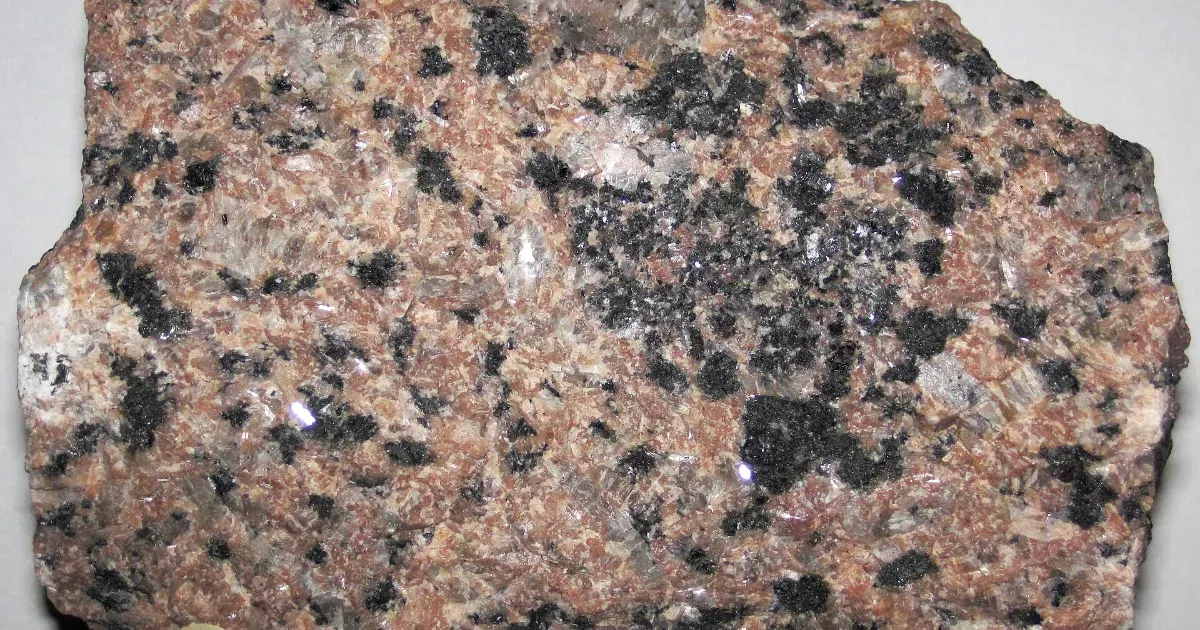
Figure 1 – Hand specimen of nepheline with greasy luster and pinkish-gray color. Photo: Shannon Heinle, GeoDIL collection, CC0 (Wikimedia Commons)
Name and History
The name nepheline comes from the Greek nephele, meaning "cloud", and was introduced in 1801 by the French mineralogist René Just Haüy. The name reflects the mineral's behavior in acid: clear fragments of nepheline gradually turn cloudy in hydrochloric acid as the structure breaks down and forms a silica gel. This remains one of the simple tests for distinguishing nepheline from feldspars.
A variety with a greasy luster and gray, green or reddish-brown colors, typical of coarse-grained intrusive rocks, was called elaeolite in older literature, from the Greek word for "oil". The name is now obsolete, and all such material is simply nepheline.
Chemical Formula and Crystal Chemistry
Nepheline's simplified formula is usually written (Na,K)AlSiO4, but natural nepheline is never pure sodium. The ideal formula of natural nepheline, with a sodium-to-potassium ratio of 3:1, is:
- Ideal formula (Buerger composition): KNa3Al4Si4O16, or Na3K(AlSiO4)4
- Sodium end-member: NaAlSiO4 (can be synthesized but is not stable on its own in nature)
- Potassium end-member: kalsilite, KAlSiO4
Three main substitutions occur in natural nepheline:
- Na–K substitution: the Na/K ratio varies with crystallization temperature and magma composition. Plutonic nephelines are usually close to 3:1, while volcanic nephelines can contain much more potassium.
- Excess silica and vacancies: through the substitution ☐Si4+ ← (Na,K)+Al3+, some silica beyond the ideal ratio enters the structure and creates vacancies in the potassium site.
- Calcium: through Ca2+☐ ← 2Na+, small amounts of calcium enter the sodium site.
Minor ferric iron (Fe3+) can also replace aluminium in the framework. This matters for glass and ceramics, because part of the iron in nepheline syenite sits in the nepheline lattice itself and cannot be removed by magnetic separation.
Crystal Structure: A Stuffed Tridymite
Nepheline crystallizes in the hexagonal system, space group P63, with unit-cell dimensions of approximately a ≈ 9.99 Å and c ≈ 8.37 Å. Its structure is described as a stuffed derivative of tridymite: a framework of linked tetrahedra similar to tridymite (a polymorph of SiO2) in which half of the silicon is replaced by aluminium. The resulting charge deficit is balanced by sodium and potassium cations that occupy cavities in the framework.

Figure 2 – Schematic crystal structure of nepheline viewed along the c axis, showing hexagonal channels (A site, potassium) and oval channels (B site, sodium). Diagram: Soorin Aras
Two Types of Cation Sites
- A site (hexagonal channel): a large, regular cavity with 9-fold coordination that hosts the large potassium ion. Vacancies related to excess silica are concentrated here.
- B site (oval channel): a smaller, elongated cavity with 8-fold coordination that mainly hosts sodium and occasionally calcium.
Each unit cell contains two A sites and six B sites, and this 1:3 geometric ratio is the structural reason why the K:Na ratio of natural nepheline is close to 1:3. The tetrahedra occupy four independent sites (T1–T4), and in most samples Si–Al ordering is nearly complete: T1 and T4 are Al-rich, while T2 and T3 are Si-rich. A general feature of nepheline is the presence of satellite reflections in its diffraction pattern, indicating nanoscale modulated structures.
The Nepheline–Kalsilite Solid Solution and the Morozewicz–Buerger Convergence Field
Natural nepheline compositions are usually plotted in the ternary system NaAlSiO4–KAlSiO4–SiO2 (nepheline–kalsilite–silica). At magmatic temperatures there is extensive solid solution between nepheline and kalsilite, but as the rock cools, nepheline compositions converge on a narrow, well-defined range.
Classic studies show that nepheline in slowly cooled intrusive rocks such as nepheline syenites plots between two reference compositions:
- Buerger composition: Na3K(AlSiO4)4, equivalent to Ne75Ks25, with no excess silica.
- Morozewicz composition: a similar Na/K ratio but with some excess silica.
This range is known as the Morozewicz–Buerger convergence field, and many geologists use nepheline composition as a geothermometer, because nephelines that crystallized at higher temperatures contain more potassium and excess silica. Rapidly cooled volcanic nephelines can reach about Ne55Ks45.
Physical Properties of Nepheline
- Hardness: 5.5–6 on the Mohs scale (slightly softer than feldspar and much softer than quartz)
- Density: 2.55–2.66 g/cm³
- Cleavage: poor in two directions (prismatic and basal); subconchoidal fracture
- Luster: vitreous in clear crystals and greasy in coarse masses
- Color: colorless, white or gray; green, yellowish-brown or reddish when impure or altered
- Crystal habit: short hexagonal prisms; in intrusive rocks usually anhedral, filling spaces between feldspars
- Reaction with acid: decomposes readily in HCl, forming a silica gel
The lack of distinct cleavage, the greasy luster and the absence of typical feldspar twinning are useful field clues. Unlike quartz, nepheline also weathers faster on exposed rock surfaces, leaving small pits.

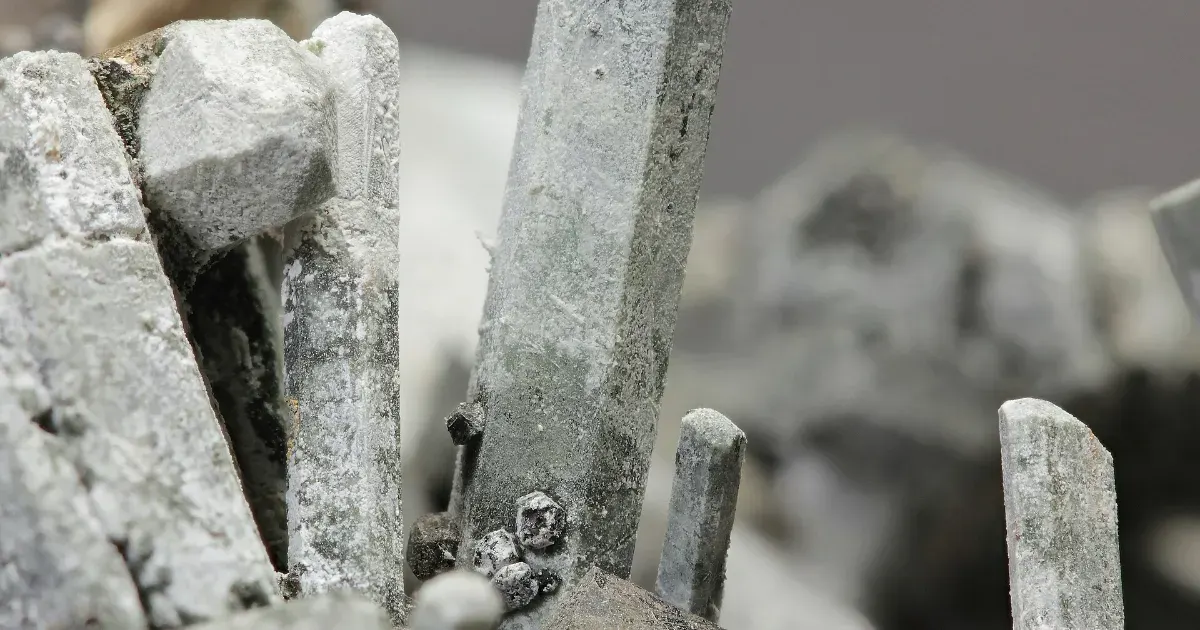
Figure 3 – Hexagonal prismatic nepheline crystals from Morocco (field of view 20 mm). Photo: Jyrki Autio, public domain (Wikimedia Commons)
Optical Properties and Identification in Thin Section
Under the polarizing microscope, nepheline has subtle, sometimes deceptive optical properties and is easily mistaken for feldspar or quartz. Its key optical characteristics are:
- Optic sign: uniaxial negative (−)
- Refractive indices: nω = 1.529–1.546 and nε = 1.526–1.542; low relief, close to Canada balsam
- Birefringence: very low, 0.003–0.004; dark gray to first-order gray interference colors
- Twinning: usually absent (unlike the polysynthetic twinning of plagioclase or the tartan twinning of microcline)
- Extinction: parallel in longitudinal sections of euhedral crystals

Figure 4 – Thin section of a euhedral nepheline crystal in plane-polarized light (PPL): colorless with low relief. Photo: Ringwoodit, CC BY-SA 4.0 (Wikimedia Commons)

Figure 5 – The same crystal in cross-polarized light (XPL). The hexagonal basal section appears almost extinct (black) because nepheline is uniaxial. Photo: Ringwoodit, CC BY-SA 4.0 (Wikimedia Commons)
Distinguishing Nepheline from Similar Minerals
- From quartz: quartz is uniaxial positive, has higher birefringence (0.009) and never alters, while nepheline is negative and often cloudy or altered. Quartz and nepheline are also not stable together in the same igneous rock.
- From alkali feldspar: feldspars are biaxial, have clear cleavages and distinctive twinning, and slightly higher birefringence.
- Staining test: in the laboratory, a polished surface or uncovered section is etched with acid and stained with dyes such as methylene blue or malachite green. Nepheline takes up the stain because it gels, which separates it from feldspar.
Alteration of Nepheline
Nepheline is chemically less stable than feldspars and alters quickly in the presence of hydrothermal fluids and weathering. Common alteration products are:
- Cancrinite: a carbonate-bearing feldspathoid formed when nepheline reacts with CO2-rich fluids.
- Sodalite: a chlorine-bearing feldspathoid with a characteristic blue color, formed by the introduction of chlorine.
- Zeolites: especially natrolite and analcime at lower temperatures.
- Fine-grained mica and clay minerals: assemblages known in older literature by names such as "gieseckite" and "liebenerite".

Figure 6 – Polished nepheline syenite from Litchfield, Maine, USA, with nepheline, albite and cancrinite. Photo: Douglas Watts, CC BY 3.0 (Wikimedia Commons)
Industrially, nepheline alteration has two important consequences: it lowers the effective Na2O and Al2O3 content and increases volatiles (loss on ignition, LOI), and it can produce fine clay minerals that change grinding and separation behavior. For this reason, the freshness and degree of alteration of nepheline are carefully assessed when evaluating a deposit.
Thermal Behavior and Industrial Importance
Pure sodium nepheline transforms to its high-temperature polymorph, carnegieite, at about 1250 °C, and the sodium end-member melts at about 1526 °C. What makes nepheline syenite an outstanding flux, however, is the combination of nepheline with alkali feldspars: this assemblage melts at temperatures far below those of either mineral alone, producing a melt rich in alumina and alkalis.
- In glass: nepheline brings the alumina needed for chemical durability into the batch together with alkalis, and helps lower the melting temperature.
- In ceramics and glazes: thanks to its high total alkalis (usually more than 14% Na2O+K2O in commercial grades), it forms a glassy phase earlier than feldspar and allows lower firing temperatures.
- In fillers: the absence of free silica and a refractive index close to that of resins make nepheline syenite a transparent, safe filler.
Conclusion
Nepheline is a hexagonal mineral with a stuffed-tridymite structure and an inherent Na:K ratio of about 3:1. Its structural features — the A and B sites, excess silica, and Ca and Fe substitutions — directly affect the chemistry of the final product. Its subtle optical properties (uniaxial negative, very low birefringence) make accurate identification a matter of experience and complementary methods, and its sensitivity to alteration makes quality assessment of the deposit essential.
In part two of this series, we look at the complete mineral assemblage of nepheline syenite: feldspars, associated feldspathoids, mafic and accessory minerals, and the difference between miaskitic and agpaitic nepheline syenites.
Sources: Mindat (Nepheline); Frontiers in Earth Science (2018), Crystal Chemistry of Three Volcanic K-rich Nepheline Samples; Deer, Howie & Zussman, Rock-Forming Minerals; Wikipedia (Nepheline syenite). Images from Wikimedia Commons under the licenses stated.